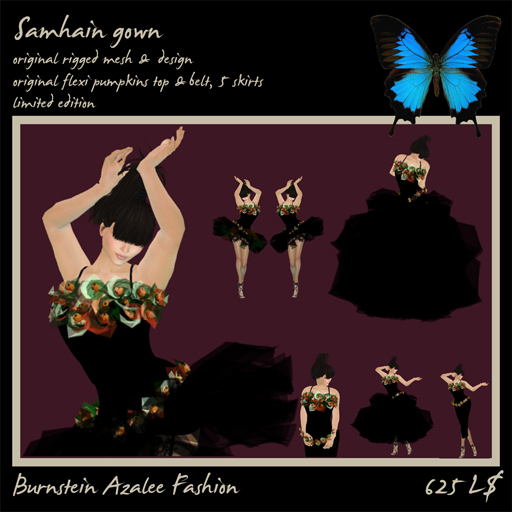


SAMHAIN gown from Burnstein Azalee Fashion
_________________________________________
* iridescent silk
* genuine design, original textures
* original rigged mesh short dress & long skirt in 5 curvy female sizes : XS, S, M, L, XL (add to worn)
* 3 different alpha layers for dress for perfect fitting
* conforms to the natural movement of your avi, just like in RL (rigged meshes)
* resizable flexi top & belt
* 4 flexi skirts: 2 short, long & gown skirt
* amazing Samhaine inspired belt & top
* wear it by "adding to worn"
* Samhaine black underware [tattoo]
Perms: copy
*********************
Halloween or Hallowe'en, also known as All Hallows' Eve, is a yearly celebration observed in a number of countries on October 31, the eve of the Western Christian feast of All Hallows (or All Saints) and the day initiating the triduum of Hallowmas, the time in the liturgical year dedicated to remembering the dead, including saints (hallows), martyrs, and all the faithful departed believers.
According to many scholars, All Hallows' Eve is a Christianized feast initially influenced by western European harvest festivals, and festivals of the dead with possible pagan roots, particularly the Celtic Samhain. Other scholars maintain that it originated independently of Samhain and has solely Christian roots.
Halloween or Samhain had its beginnings in an ancient, pre-Christian Celtic festival of the dead. The Celtic peoples, who were once found all over Europe, divided the year by four major holidays. According to their calendar, the year began on a day corresponding to November 1st on our present calendar. The date marked the beginning of winter. Since they were pastoral people, it was a time when cattle and sheep had to be moved to closer pastures and all livestock had to be secured for the winter months. Crops were harvested and stored. The date marked both an ending and a beginning in an eternal cycle.
The festival observed at this time was called Samhain (pronounced Sah-ween). It was the biggest and most significant holiday of the Celtic year. The Celts believed that at the time of Samhain, more so than any other time of the year, the ghosts of the dead were able to mingle with the living, because at Samhain the souls of those who had died during the year traveled into the otherworld. People gathered to sacrifice animals, fruits, and vegetables. They also lit bonfires in honor of the dead, to aid them on their journey, and to keep them away from the living. On that day all manner of beings were abroad: ghosts, fairies, and demons--all part of the dark and dread.
Samhain became the Halloween we are familiar with when Christian missionaries attempted to change the religious practices of the Celtic people. In the early centuries of the first millennium A.D., before missionaries such as St. Patrick and St. Columcille converted them to Christianity, the Celts practiced an elaborate religion through their priestly caste, the Druids, who were priests, poets, scientists and scholars all at once. As religious leaders, ritual specialists, and bearers of learning, the Druids were not unlike the very missionaries and monks who were to Christianize their people and brand them evil devil worshippers.
*********************
* Purchases of any Burnstein Azalee Fashion products grants you license to use it in the Second Life® world.
* All rights are reserved. PROHIBITED is any reproduction and/or distribution, even partial, on Second Life® and in others Grids
* Our Products are licensed to be used within Second Life® world only. IS NOT ALLOWED to export them in other grids.
Infringements of these terms of use will be subjected to DMCA (Digital Millemium Copyright Act), i.e. United States copyright law that criminalizes production and dissemination of technology, devices, or services intended to circumvent measures that control access to copyrighted works.
Ver el artículo en Second Life


