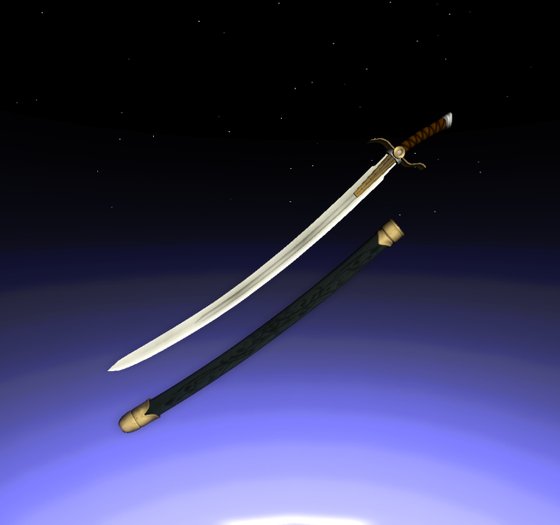

A Shamshir (from Persian: شمشیر also, Shamsheer and Chimchir.) is a type of sabre with a curve that is considered radical for a sword: 5 to 15 degrees from tip to tip. The name is derived from Persian شمشیر shamshīr, which means "sword" (in general). The radically curved sword family includes the shamshir, scimitar, Talwar, kilij, and the Turko-Mongol saber.
A Shamshir Shikargar (Persian: شمشیر شکارگر; literally, "hunters' sword" or "hunting sword") is the same as a shamshir, except the blade is engraved and decorated, usually with hunting scenes.
Originally Persian swords were straight and double edged, just as Indo-Persian khanda. The curved scimitar blades were Central Asian in origin. The earliest evidence of curved swords, or scimitars, is from the 9th century, when it was used among soldiers in the Khurasan region of Persia. The sword now called "shamshir" was popularized in Persia by the early 16th century, and had "relatives" in Turkey (the kilij), the Mughal Empire (the talwar), and the adjoining Arabian world (the saif) and (the sam-saam).
The shamshir is a one-handed, curved sword featuring a slim blade that has almost no taper until the very tip. Instead of being worn upright (hilt-high), it is worn horizontally, with the hilt and tip pointing up. It was normally used for slashing unarmored opponents either on foot or mounted; while the tip could be used for thrusting, the drastic curvature of blade made accuracy more difficult. Like Japanese blades, there is no pommel, and its two lengthy quillons form a simple crossguard. The tang of the blade is covered by slabs of bone, ivory, wood, or other material fastened by pins or rivets to form the grip.
The shamshir was similar in design to its contemporaries, the Mughal Talwar and the Saif.
Thank you for your purchase and we hope you'll enjoy your new weapon!
- HUDless Activation (Clic)
- Normal And Sculpted prims
- High quality textures and crafting
- Mid-Prim Range, below 100 prims.
- inspired by real life weapons
