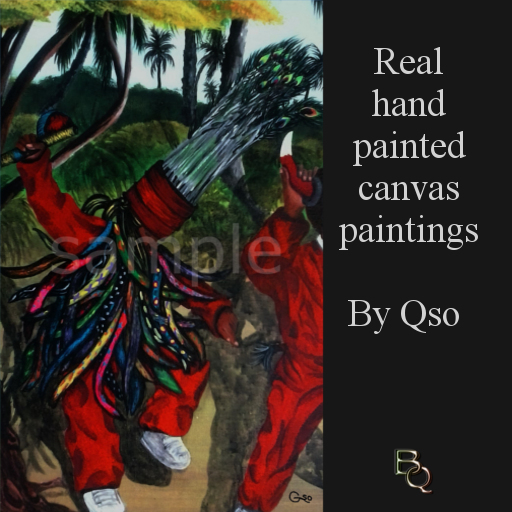

REAL acrylic canvas paintings done by my self :)
I am bringing them to second life to share with u all.
This is a painting mounted on canvas.Click on the painting and you will receive a note card that contains the artist bio and artistic expression.
My art usually holds some deep rooted meaning, not all is what it seem :)
Artistic Expression:
Masquerade
Masquerade in St Kitts can be described as an artform created by the syncretic coming together of peoples of African and European descent over a period of 300 years.
The earliest account of the masquerade in St Kitts was reported by Alfred Williams and English historian and cultural observer. Ids eyewitness account as early as the 1890's noted that the masquerade wore feathered headdresses and leggings and carried tomahawks. Antonio Williams, an English tourist, in her diary entitled "A Tour Through the West Indies 1908 - 1909," also described the masquerade dancers she saw wearing tall peacock feathered headdresses, masks, trousers and long-sleeved shirts. Over the trousers or leggings, she described skirt-aprons that were completely fringed and reached just above the knees. She added that the entire costume was decorated with bangles, mirrors and ribbons.
Migration of people from St Kitts - Nevis during the 1920's saw the spread of the artform to other areas of the Caribbean, including Bermuda and the Dominican Republic, where it is well established today. According to Dr Vincent Cooper, the tradition seems to have been stronger in Nevis, the more aural of the two islands, and rural towns such as Cayon and Phillips' which have longstanding ties with Nevis provided the breeding ground from which the artform flourished and spread to other areas on St Kitts.
Dance experts have identified elements of European and African dance forms, which include the "Wild Dance," the Waltz, and Quadrille, the Rhumba, the Fertility Dance, the Fine Dance, the Jig and the Boillola. The Masquerade dancers are usually accompanied by a group of musicians playing a fife, a kettle drum and a big drum, and African Caribbean rhythm patterns.
As we enjoy the spectacle of colours, music and dance of the masquerade this Christmas, let us all salute the memory of Rupert Samuel for his outstanding contribution to this important aspect of our folklore.
The dance 'forms of the masquerades exemplify elements of African and European genres. The French seemed to have had a large influence, especially during the governorship of PhiIlipe de Poincy who is reputed to have hosted troupes of dancers from France at his chateau at Fountain Estate. The names of three of the six dances of the masquerades can be attributed to French origins. These are the "Quadrille", the "Fine", and the "Jig" which is said to home come from the French word "gigue".
The "Quadrille" which has its roots.-in 17th-Century France is the first dance and danced by couples to a slow, structured pace defined by the country and elegance of the various dance figures.
The "Fine" which is the second dance is decidedly faster and demands greater skill as the dancers dance on one foot towards each other meeting in the centre of the ring and performs a fertility dance which is traceable to the mating dance of Africa.
The real spectacle in dance comes when the masquerades break into a frenzy of "Wild Mas" throwing their tomahawks into the air much to the delight of onlookers.
The "Jig" introduces a new dance position where the right foot hooked behind the left foot, the dancer displays his skill with the tomahawk. This dance follows right into the "Boillola" another dance movement where the tomahawk is held between their legs while the dancers jump and clap to the music, moving from side to side.
The mimicry of Europeans in dance is perhaps best reflected in the "Waltz" where the dancers pair off into couples and perform simple ballroom dance steps to a moderately fast triple meter. The curtains come down on the dances with an appreciative bow to the audience. "A so ee go".
- Real acrylic canvas painting
