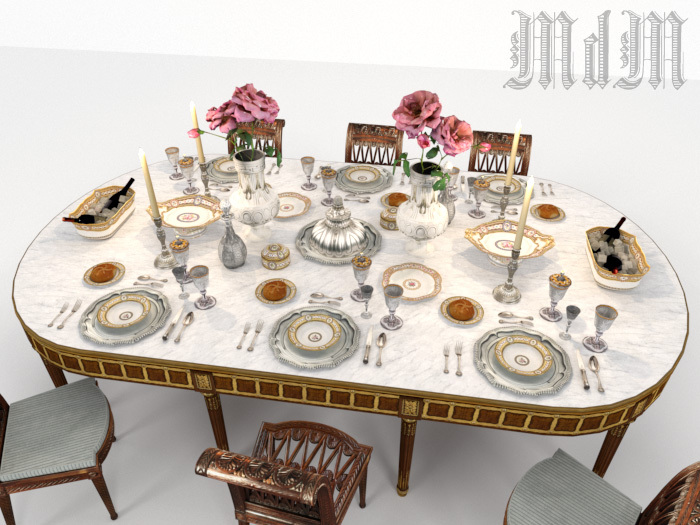
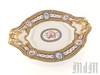
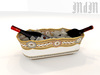
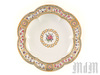
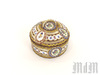
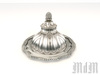
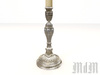
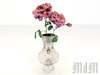
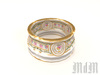
The collection "Marie Antoinette Service" contains all the pieces to recreate the perfectly accurate 18th century royal dining table. The service is an impressive example of the outstandingly elegant products made in the French porcelain manufactory at Sèvres.
At the very beginning of the year 1784, Queen Marie-Antoinette ordered from the Sèvres manufactory a table service with a particularly refined decoration of flowers which was called in the documents "a frieze rich in colors and rich in gold". The set, which included more than 300 pieces, was put into production in February 1784. But on June 22, 1784, during the visit of King Gustav III to France, Louis XVI offered the Swedish sovereign this service originally intended for the queen. A second set was immediately implemented in Sèvres for Marie-Antoinette.
The sumptuous decoration consists of roses, faux pearls and pansies in medallions, on a carmine ground.
The Dish Ring and Decanter can only be found in "Marie Antoinette Service - Full Pack" or "Grande Salle a Manger - Full Pack"
----------------------------------------------------------------------------------------------
The collection contains:
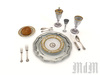
Service (Picture 3)
The "Service à la Russe" (French for "service in the Russian style") is a manner of dining that involves courses being brought to the table sequentially, and the food being portioned on the plate by servants (usually at a sideboard in the dining room) before being given to the diner. It became the norm in very formal dining in the Western world over the 18th and 19th centuries.
The place setting (called a cover) for each guest includes a service plate, all the necessary cutlery, and glasses for water, wines and champagne.
The cutlery to the left of the service plate is salad and dinner forks, ant the right is dinner knife and soup spoon, and at the top is the dessert fork and spoon.
On left side is the bread or the butter plate.
Tureen Stand (Picture 4)
This beautiful Tureen Stand can be used for serving desserts or other decorative food arrangements. It is best used with the dish ring, for ultimate appearance.
Wine Cooler (Picture 5)
This cooler, intended for liqueur or wine bottles, is fitted for two large bottles. The ice would be place on top to cool the wine for a long period of time.
Serving Plate (Picture 6)
A large plate that served for variety of food arrangements and displays. It's very unusual and beautiful shape makes it perfect for any food presentation.
Butter Dish (Picture 7)
Before refrigerators existed, a covered dish made of crystal, silver, or porcelain housed the butter. A French butter dish, keeps butter fresh by using water to keep the butter away from the air, thereby keeping it fresh. The water is placed into the base of the dish and the butter is put into a bell-shaped lid, creating an air seal.
Central Silver Dish (Picture 8)
This silver plate and cover is very similar to those in the Orloff service, and it is marked by the silversmith responsible for many pieces in that celebrated set, Jacques-Nicolas Roettiers in 1781. This tureen is very similar to those in the Orloff service.
Candlestick (Picture 9)
This Candlestick was also made by Parisian silversmith Jacques-Nicolas Roettiers in 1784
Sevres Vase (Picture 10)
This Sèvres 'Vase Grec à Ornements' made out of Biscuit porcelain in around 1764. The author is probably Jean-Claude Duplessis. The vase is of baluster form, eith fluted pedestal, and the base with acanthus leaves and compartments surmounted by a band decorated with twelve medallions including six decorated with profiles of Roman Emperors.
Dish Ring (Picture 11)
This dish ring is a refined example of aristocratic dining. Such rings were used on the dining table as a base for a larger bowl or plate that was laden with beautifully arranged food. As a 18th century writer explained “to make the feast look full and noble.” A series of rings of different heights made for a prosperous but not necessarily an aristocratic table.
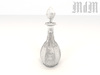
Decanter (Picture 12)
A decanter is a vessel that is used to hold the decantation of a liquid (such as wine) which may contain sediment. Decanters, which have a varied shape and design, have been traditionally made from glass or crystal. Their volume is usually equivalent to one standard bottle of wine (0.75 litre). This decanter is made from beautiful Bohemian crystal.
----------------------------------------------------------------------------------------------
You can adjust the intensity of the shadows beneath the objects by selecting the face of the shadow and lowering the transparency to your liking.
For Land impact you can see the objects in world.
Copy and Modify rights.
