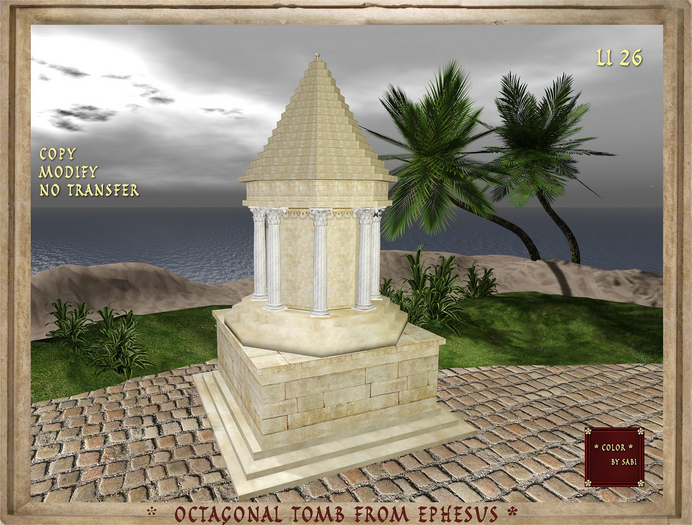









Octagonal tomb from Ephesus - Historical reconstruction
*********************************************
Copy/Modify/No Transfer - 26 Land impact
(7.7x7.7x12)
Built based historical model and references, the octagonal tomb/monument fit everything, from ancient to modern time periods, giving to your scene the touch of elegance and authenticity.
It may be proper gift for any occasion!
The monument/mausoleum/tomb is historical attempt reconstruction of the supposed tomb of Arsinoe IV.
Note: the modify feature of the item gives the possibility to adapt it dimensions to your desired emplacements and architectural plans. Increasing the item size will increase the land impact.
********************************************
Reference:
The Octagon is a burial monument from Ephesus.
Dating back to the late 1st century BC, this building was a monumental eight-sided mausoleum, originally surrounded by a Corinthian colonnade, standing on a square base. It was covered, most possibly, with a steep pyramidal roof, a novel architectural solution. All visible parts were made of white marble.
The Octagon was discovered in 1904, and it was first interpreted as a trophy-monument. However, further excavations carried out in 1929, found a burial chamber situated on the top of the basal structure. Inside, there was a sarcophagus with the skeleton of a young woman of 15-18 years at the time of her death. Unfortunately, the skull of the skeleton was later lost in Germany during the Second World War. In classical antiquity, intramural burials were reserved for the most prominent persons, such as heroes, wealthy sponsors of public buildings, or influential politicians. Thus, the archaeologists were more than surprised to discover the mausoleum apparently erected to honour a very young woman. As no inscription was found to explain who it had been, the riddle is still unsolved.
However, a sensational suggestion was made in the 80-ties of the 20th century. Hilke Thür of the Austrian Academy of Sciences suggested that it was the tomb of Arsinoë, an Egyptian princess murdered in 41 BCE by Mark Antony, at the instigation of Cleopatra VII. The dating of the tomb seemed to confirm this theory as it was dated to the period between 50 and 20 BC. Moreover, the octagonal plan of the monument that resembles the second tier of the Lighthouse of Alexandria and the pyramidal shape of the mausoleum's roof seemed to point out in the direction of Egypt. However, the carbon-dating of the bones conducted in that period gave an extensive range of dates, between 200 and 20 BCE.
The sensational idea that the Octagon is the tomb of Arsinoë IV is still widely accepted. Even the official information board placed on-site claims, although cautiously, that "the grave was probably Arsinoë IV, youngest sister of Cleopatra and murdered at Ephesus. If the monument is the tomb of Arsinoë, this would be the only case when the remains of the Ptolemaic dynasty member have been recovered. This fact is even more surprising as this dynasty ruled Egypt for almost 300 years.
(From Turkish Archaeological News)
*********************************************
Do not hesitate to ask titusiuliussabinus if have questions.
Join the * Color * by Eve & Sabi group InWorld, in order to receive updates about the new releases, benefit of discounts and gifts.
Group members have 20% discount if buy from the store wall vendors (holo vendors not include discounted prices)!
Visit the twin * Color * by Eve marketplace or InWorld store for the matched timeline decorations!
Thank you shopping. Enjoy our creations for yourself or as gifts for friends!
Veja o item no Second Life- High quality
- Good load
- Low land impact
- Historical reconstruction
- 3D model


