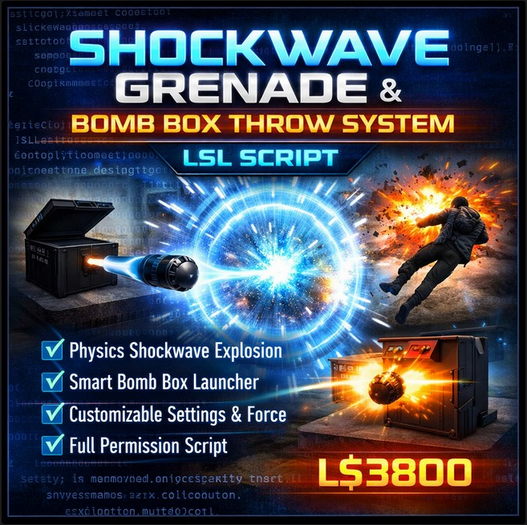

If you want a clean, reliable, and visually impressive explosion system in Second Life, this Shockwave Grenade and Bomb Box Throw System gives you exactly that — without messy setups, complicated linking, or heavy scripts that drag performance down.
This is a complete physics-based interaction system built entirely in LSL, designed for creators who want realistic motion, satisfying impact, and simple deployment. Whether you’re building combat games, arena challenges, roleplay mechanics, training simulations, or interactive experiences, this system gives you a plug-and-play explosive with intelligent throw mechanics and smooth shockwave effects.
Let’s break down what you’re getting.
At the core is the Shockwave Grenade Script, which handles the entire explosion behavior. When rezzed, the grenade behaves as a physical object. It drops naturally, waits for its fuse, then detonates with a radial push force that reacts to distance. Objects and avatars closer to the center receive stronger force, while those near the edge get a lighter push. This creates a believable physical reaction instead of a flat or unrealistic blast.
The explosion isn’t just functional — it looks good too. The script generates an expanding energy wave using particle effects that visually match the blast radius. The wave grows outward rapidly, fades smoothly, and disappears cleanly. No lingering particles. No clutter. No extra lag.
Everything is calculated using linear falloff physics, which means force decreases proportionally over distance. That gives you consistent and predictable behavior — ideal for gameplay balance or structured simulations.
Then comes the second component: the Bomb Box Throw System.
This is the launcher container that makes the system interactive and easy to use. Instead of manually rezzing grenades, you simply place the grenade object inside the Bomb Box inventory. When an avatar clicks the box — including in first-person or mouse-look — the script rezzes a copy of the stored object directly in front of them and throws it forward with controlled velocity.
The direction of the throw is based on the avatar’s facing rotation. So wherever they aim, the grenade goes. This makes the experience feel natural and intuitive without requiring HUDs, attachments, or complex controls.
The original object inside the box is never consumed. The script rezzes copies only, which means unlimited use as long as permissions allow it. This makes it perfect for multiplayer environments, public game zones, or reusable systems where you don’t want inventory management headaches.
Setup is straightforward. Drop the scripts into your objects, place the grenade inside the Bomb Box, and you’re done. No linking requirements. No external controllers. No configuration notecards needed unless you want customization.
And customization is where this system really shines.
Both scripts expose simple variables you can adjust — blast radius, push force, fuse time, throw speed, spawn distance, launch arc. You can fine-tune behavior to match arcade gameplay, realistic physics simulation, or controlled event mechanics. Builders who like control will appreciate how easy it is to tweak without rewriting logic.
Performance is another strong point. The grenade runs physics only while active, performs a single sensor scan at detonation, triggers particles briefly, and then deletes itself automatically. That means minimal script time usage and automatic cleanup. You can run multiple explosions in busy regions without performance stacking.
Because the system uses native push mechanics, it interacts properly with physical objects. Crates, debris, props, or any physics-enabled items respond naturally to the blast. This makes it especially useful for destructible environments, reaction puzzles, and kinetic gameplay design.
Full permissions are included, which means you can modify, resell within your builds, integrate into game systems, or customize for client work. There are no locked components, no hidden dependencies, and no external assets required beyond the included texture reference (which you can replace anytime).
This is not just a visual toy — it’s a practical building tool for creators who want physical interaction that feels responsive and believable.
Common use cases include:
• Multiplayer mini-games
• Combat arenas
• Training simulations
• Physics playgrounds
• Roleplay environments
• Escape rooms
• Competitive challenges
• Interactive exhibitions
• Script learning references
• Custom weapon systems
If you build interactive experiences in Second Life, having a clean explosive system like this saves hours of scripting and testing.
You don’t need to figure out push math.
You don’t need to build particle expansion logic.
You don’t need to manage rez direction calculations.
It’s already done — and done properly.
- ✔ Realistic physics shockwave with distance-based push force
- ✔ Smart Bomb Box launcher with directional throwing
- ✔ Expanding visual blast wave with clean particle effects
- ✔ Fully customizable settings (force, radius, fuse, velocity)
- ✔ Full permission scripts — modify, resell, integrate freely