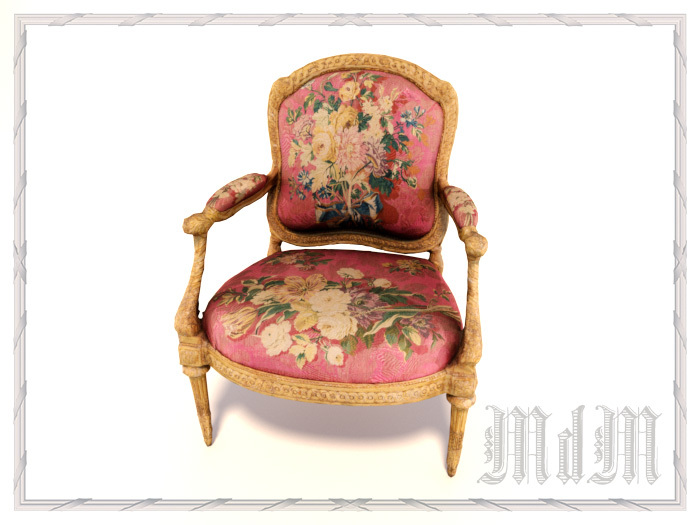

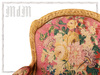
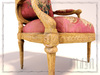
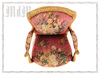
An Early Louis XVI Fauteuil (Open-arm chair) made by Jean-Baptiste Claude Sené in circa 1775 for the Grand Cabinet at Château de Saint-Cloud, near Paris. It has arched Serpentine shape back, padded arms and seat covered in close-nailed Beauvais tapestry depicting big flower bouquets, made from the drawings of François Boucher. The decoration is guilloche-carved with foliate finials, above foliate-wrapped arms and curved supports, and a conformingly-carved seatrail, on turned tapering fluted legs headed by rosette paterae and terminating in toupie feet.
The transition period between Louis XV and XVI (1750-1774), the rococo style went out of fashion before King Louis XV's death, inspired by the discovery of ancient Pompeii brought back a return of Greco-Roman style in furniture and architecture. During this transition period, the style slowly transitioned from the charming ornate rococo shapes and just a slight cabriole leg. Louis XVI reign began in 1774 and his queen Marie-Antoinette was a lover of the arts and had much influence over this style. She embraced geometric shapes of replaced rococo curves, chair backs now were oval or rectangular and the classic straight tapering legs resembling a tapering Roman column or quiver, superseded ornate cabriole legs.
The matching Sofa is not included and can be bought separately in my shop.
You can adjust the intensity of the shadows beneath the chairs by selecting the face of the shadow and lowering the transparency to your liking.
Contains 4 female and 3 male sitting poses.
Land impact is 3 for every size below the 1.22m of height.
Number of triangles: 8516
Copy and Modify rights.


Magnifique
Fauteuil tout simplement magnifique. Merci.


